
Yoga for Stress Relief, breathwork and deep rest calm stress and anxiety in women, what the research says, and safe practices for Indian women at...
Read Morewhat changes after 30
Yoga for Strength and Flexibility for Women
Live, online and built around your joints, your history and your week. For women who feel stiff, weaker than they used to, or simply out of practice.
Does yoga help for Strength?
Yes, yoga builds real strength and flexibility, provided it is progressive and held long enough to load the muscles. In trials with adults over 60, yoga improved leg strength, lower-body flexibility and balance compared with doing nothing. Our programme applies that to women's bodies after 30: slow, loaded poses for muscle and bone, mobility work for stiff hips and spines, and breath and rest so the body can recover. Three live sessions a week, adapted to any condition you bring.
Key takeaways
- Adults, women included, lose roughly 3–8% of muscle mass per decade after 30, faster after 60. Strength work slows that.
- Yoga counts as strength training when poses are held, repeated and progressed, not rushed.
- Flexibility comes fastest when strength comes with it: a joint you can control is a joint you can open safely.
- Stiffness, arthritis or low bone density are reasons to adapt the practice, not to avoid it.
- Most women notice easier movement within weeks; strength and posture changes take around twelve.
Book your Health & Movement Assessment — ₹99 (India) / $19 (international), credited in full to your first month
Who this programme is for
You will feel at home here if any of these sound like you:
- You get up from the floor with a hand on the sofa, and you have started to notice.
- Your hamstrings, hips or lower back feel tight every morning, even after rest.
- You sit for eight or nine hours, and your neck and shoulders carry it.
- You stopped exercising after a baby, an injury or a busy decade, and do not know where to restart.
- Your doctor mentioned bone density, muscle loss or “strength training”, and a gym is not for you.
- You have arthritis, a disc issue, thyroid or PCOS, and generic classes left you sore or nervous.
- You tried fast online classes with twenty-five squares on screen, and nobody checked your knees.
You do not need to be flexible, fit or experienced. Most women start here after years away from exercise.
Can yoga really build strength, or is it just stretching?
Yoga builds strength the same way any resistance training does: a muscle works against a load, and the load increases over time. In yoga, the load is your own body weight, the length of the hold and the leverage of the pose. A chair pose held for five breaths is a squat. A plank progressed to a slow lowering is a press-up.
What makes yoga strength work, rather than a stretch class, is three things: holds long enough to tire the muscle (roughly 30–60 seconds, built up gradually), progression (the same pose made harder week by week), and coverage of every major muscle group: legs, glutes, back, core, shoulders and arms.
It will not build bodybuilder muscle, and it is not meant to. It builds the strength women need for daily life: carrying shopping and children, climbing stairs, getting up off the floor, and protecting joints and bones as hormones change.
What changes in a woman's body after 30, and after 40
Muscle mass declines by about 3–8% per decade after 30, and the decline speeds up after 60 (Volpi et al., 2004). For women, perimenopause adds a second shift: falling oestrogen accelerates bone loss and makes joints feel stiffer. Less muscle means less support for knees, hips and the lower back, which is why aches often arrive in the same years as the stiffness.
The World Health Organization recommends muscle-strengthening activity for all major muscle groups on two or more days a week for every adult, and balance training on three or more days for older adults with poor mobility (WHO). Three sessions a week of progressive yoga meets that, at home, without a gym.
How we build strength and flexibility:
the Vibe Method
Every programme starts from a one-to-one assessment and rests on four pillars.
Move
➔
Slow, loaded poses for legs, glutes, back, core, shoulders and arms, plus mobility work for hips, spine and shoulders. Every pose has a job; nothing is there for show.
Breathe
➔
Breath sets the pace of each hold and keeps blood pressure steady under effort. It is also how we teach the core to switch on without bracing or holding the breath.
Rest
➔
Muscles get stronger between sessions, not during them. Each class ends with down-regulation so you finish calmer, not wrung out.
Track
➔
We log what you can do: hold times, range in key stretches, how you get up from the floor, pain levels. You see progress in numbers, not just feelings.
The practice draws on therapeutic hatha yoga and mat Pilates core principles. It is deliberately not a fast flow: speed hides poor alignment, and poor alignment is how knees and lower backs get hurt.
What a 60-minute session includes
| Segment | Time | What happens | Why it matters |
|---|---|---|---|
Arrive and check in |
5 min |
How you slept, any pain, where you are in your cycle |
The plan adapts to today’s body, not last week’s |
Breath and joint warm-up |
8 min |
Breath, spinal waves, ankle, hip and shoulder circles |
Warms joints and links breath to movement |
Strength block |
20 min |
Held and repeated poses: chair, bridge, lunge, plank and side-plank variations, back extensions |
Loads every major muscle group; progressed week by week |
Balance |
5 min |
Single-leg and tandem standing work, near a wall |
Protects against falls; trains the small stabilising muscles |
Mobility and flexibility |
15 min |
Longer holds for hamstrings, hips, chest and spine, with straps and blocks |
Muscles lengthen best when warm and after they have worked |
Rest and close |
7 min |
Supported relaxation or yoga nidra, plus a 10-minute home practice |
Lets the nervous system recover; keeps progress going between sessions |
What to expect over twelve weeks
Strength and flexibility are slow biology, which is why the programme is built in quarters.
- Weeks 1–4: Foundation. We find your starting point, teach safe alignment for your joints and build basic holds. Most women notice they move more easily and sleep better.
- Weeks 5–8: Build. Holds lengthen and poses progress: a supported lunge becomes a free one, a knee plank becomes a full plank. Getting up from the floor gets easier.
- Weeks 9–12: Strengthen and integrate. Harder variations, single-leg balance, deeper range in the hips and hamstrings. Posture changes become visible, and you leave with a written practice you can keep doing.
Timelines vary with age, starting fitness and any health condition. We review your progress formally at the end of every month.
Why private sessions work better for strength and flexibility
Strength work is only as safe as the alignment under it. In a group, nobody sees that your knee drifts inward in a lunge or that your lower back arches in a plank. One-to-one, your instructor corrects it in real time, chooses the right variation for your joints and progresses you when you are ready, not when the class is. That is the difference between getting stronger and getting sore.
Why Indian women often
need strength work most
Many of the women we teach grew up being told that exercise meant walking, and that lifting was for men. Add a largely vegetarian diet that can run short on protein, long indoor working days with little sun, and decades of putting family first, and many reach their forties with less muscle and stiffer joints than they expected.
We build the programme around that reality. Your instructor will ask how much protein a dal-rice-roti day really gives you and suggest you raise vitamin D and bone health with your doctor. Practice times fit around school runs, joint-family mornings and late calls. If you live abroad, in Dubai, Singapore, London or the US, sessions are set in your time zone, and the cultural shorthand comes free.
Is it safe if I have arthritis, a disc problem or low bone density?
Usually, yes, with the right adaptations, which is exactly why we assess you first. Women with these conditions often benefit most from careful strength work, because stronger muscles take load off painful joints.
We adapt the practice for: osteoarthritis and knee pain, slipped or bulging discs, sciatica, osteopenia and osteoporosis, hypermobility, high blood pressure, pregnancy and the postpartum year, and recovery after surgery.
What changes: no deep loaded forward folds or rounded twists with low bone density; no headstands, shoulder stands or plough pose for most beginners; supported versions of kneeling and floor poses for knees; no breath-holding under effort with high blood pressure.
Please check with your doctor first if: you have had surgery in the last three months, a recent fracture, an acute disc flare with leg numbness or weakness, a heart condition, or you are pregnant.
This programme works alongside your doctor’s care, never in place of it. Keep taking any prescribed medication.
Choose how you practise
Private 1-on-1 is the right answer for a named diagnosis. Many women start there, then move to a group once their practice is established.
Private 1-1 Sessions
Your body. Your goals. Your timeline.
₹10,000/month
- 12 private sessions
- Custom plan, reviewed monthly
- WhatsApp support & practice notes
- Cancel or pause any month
Group Membership
Online Group Session with Personalized Approach.
₹1,999/Month
- Upto 10 members group size
- 12 sessions per month
- Accessibility to groups at different time
Who leads the strength programme?
Shweta
Founder, women's therapeutic yoga specialist
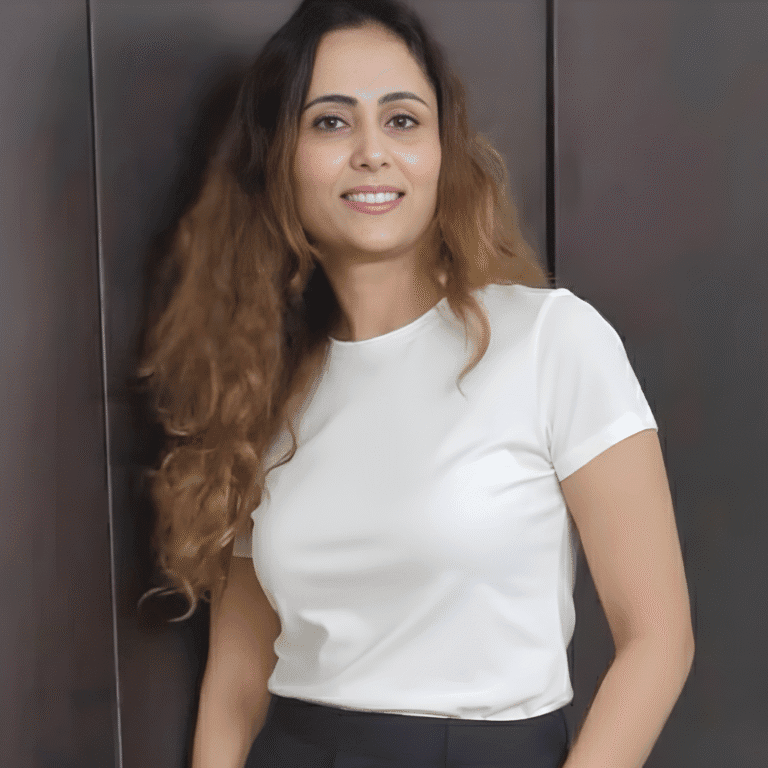
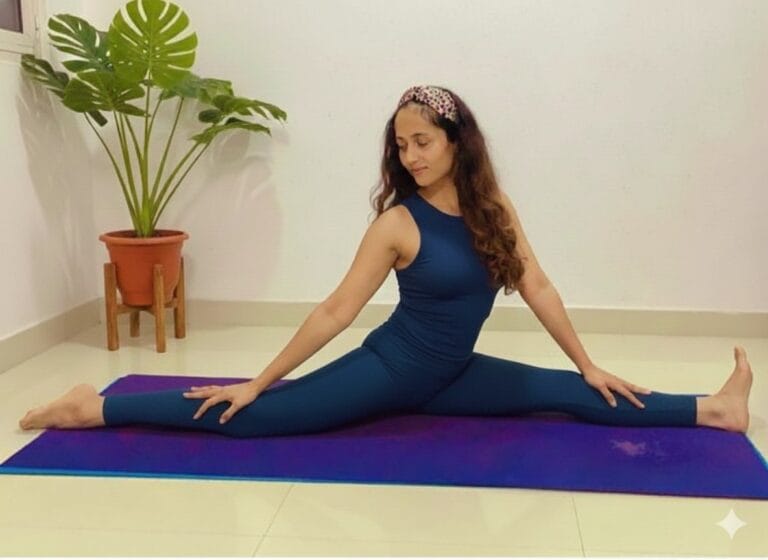
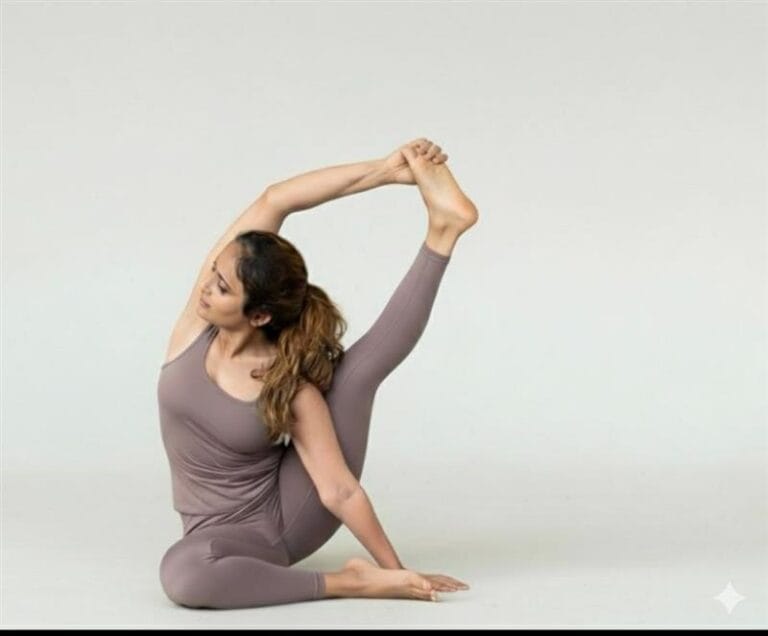
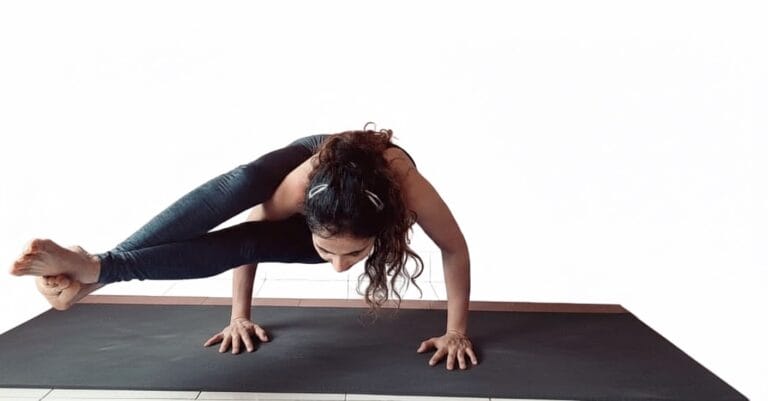
Shweta has spent ten years teaching therapeutic yoga to women with hormonal conditions, and PCOS is one of the most common reasons women come to her. She holds RYT-200, 300, 500 and 1000 certifications, is a certified pre- and postnatal yoga coach with advanced study in female anatomy and physiology, and was awarded a Doctorate in Yoga Philosophy. She has guided more than 500 women personally, in English and Hindi, across India, the Gulf, Europe and Türkiye.
Strength & Flexibility yoga — frequently asked questions
Read FAQs
What is yoga for strength and flexibility?
It is a yoga practice designed to build muscle strength and joint range together. Poses are held long enough to load the muscles of the legs, glutes, back, core, shoulders and arms, then progressed week by week, while mobility work opens stiff hips, hamstrings, chest and spine. At My Yoga Vibe it is taught live and one-to-one, adapted to your joints, age and any health condition.
Can yoga build muscle as well as weight training?
For everyday strength, yes, if it is progressive. Body-weight holds, slow lowering and single-leg work load muscles enough to make them stronger, and trials in older adults show gains in leg strength. Yoga will not build the bulk that heavy lifting can. For most women over 30, the goal is strength for daily life and joint and bone protection, and yoga covers that well.
I am very stiff and have not exercised in years. Can I start?
Yes. That is the most common starting point here. Your assessment finds what your body can do today, and week one uses straps, blocks, a chair or the wall so every pose is reachable. Flexibility is not a requirement for yoga; it is one of the results. Most women notice easier movement within the first month.
How long does it take to become more flexible and stronger?
Most women feel looser and sleep better within three to five weeks of practising three times a week. Measurable strength and posture changes usually take around twelve weeks, which is why we recommend committing to a quarter. Progress depends on age, starting point, consistency and any health conditions, and your instructor tracks it every month so you can see it.
Is yoga for strength safe with osteoporosis, arthritis or a slipped disc?
Usually yes, with adaptations, and these women often benefit most. We avoid loaded forward folds and rounded twists with low bone density, protect knees in kneeling poses, and modify for disc issues. Please check with your doctor first after recent surgery, a fracture, an acute disc flare or with a heart condition. The practice supports your medical care; it never replaces it.
How is this different from a power yoga or vinyasa class?
Fast flows move quickly from pose to pose, which builds stamina but hides poor alignment. This programme is slower and more deliberate: longer holds, careful progressions and real-time correction. It suits women who want strength without strain, especially with joint pain, low bone density or a long break from exercise. You still finish having worked hard.
How long is each session, and how many do I need a week?
Each live session runs about 60 minutes, three times a week, twelve sessions a month. That meets the WHO advice to do muscle-strengthening activity on two or more days a week. Between sessions you get a 10–15 minute home practice, so progress continues on the other days.
Can I do this online from outside India?
Yes. Sessions are live on video and scheduled in your time zone. Women join from the UAE, Singapore, the UK, Europe, Türkiye and North America, and international members pay in their own currency. Because sessions are one-to-one, your instructor watches only you, which many members find gives more correction than a studio class.
Articles on Strength & Flexibility
Explore our collection of insightful articles designed to support your wellness journey. Here, we share knowledge, inspiration, and tips to help you thrive in mind, body, and spirit.

Yoga for Infertility Among Women
Can yoga help with infertility? What the research shows, 5 gentle poses, 2 breath practices and what to avoid, reviewed by a gynaecologist.
Read More
Yoga for Menopause Relief
Yoga for Menopause - How therapeutic yoga supports hot flashes, sleep, mood, joints and bone health in perimenopause and menopause, alongside your doctor's care.
Read More