
Therapeutic yoga for women · Live online ·1-on-1 or small group
Yoga for Weight Loss for Women
When Your Hormones Are Part of the Story
Does yoga help for Weight Loss?
Yes, yoga can help women lose weight, but rarely on its own and rarely by burning calories alone. It works best as part of a plan that builds muscle, lowers stress, improves sleep and fits your hormones. For women with PCOS, thyroid conditions, postpartum changes or perimenopause, that hormone-aware approach is often what finally moves the scale.
Key takeaways
- Research reviews show regular yoga can modestly reduce BMI and waist size in overweight adults, with the clearest results when paired with changes to how you eat.
- For many Indian women, weight is a hormonal and metabolic question first: PCOS, thyroid, insulin resistance, the postpartum year and perimenopause all change where and how the body stores fat.
- Strength-focused yoga protects muscle, which matters more for long-term metabolism than calories burned in a class, especially after 35.
- Sleep and stress are not extras. In one controlled study, short sleep cut the share of weight lost as fat by more than half, even on the same diet.
- Give it 12 weeks. Waist, strength, energy and sleep usually change before the scale does.
Not sure what is driving your weight? Start with a 45-minute Women’s Health & Movement Assessment, one-to-one with our team. ₹99 in India or $19 internationally, credited in full against your first month.
even though I'm eating less
Why can't I lose weight?
If you have cut portions, walked daily and the scale has barely moved, you are not imagining it and you are not lacking willpower. For women, weight is shaped by hormones, sleep, stress and life stage as much as by food and exercise. These are the patterns we see most often in our sessions.
PCOS and insulin resistance
➔
With PCOS, the body often has to produce more insulin to manage the same meal. Higher insulin makes it easier to store fat around the middle and harder to release it, and it can drive the 4 pm sugar cravings many women describe.
Thyroid (hypothyroidism and Hashimoto's)
➔
An underactive thyroid slows the body’s energy use and can bring fatigue, puffiness and weight gain that does not respond to dieting. Medication comes first and your doctor manages it.
After pregnancy
➔
ostpartum weight sits on top of a stretched core, a recovering pelvic floor, broken sleep and, often, breastfeeding. Crunches and jumping workouts too early can worsen abdominal separation or leakage.
Perimenopause and after 40
➔
A long-running US study of women through menopause (SWAN) found that about two years before the final period, the rate of fat gain doubles and lean muscle starts to decline, which is why weight settles around the waist on the same food and effort.
Stress, long hours and poor sleep
➔
Working women who sleep five or six hours, eat at their desks and run on chai often carry stubborn weight even when the diet is reasonable. In one controlled study, people on the same reduced-calorie diet lost 55% less fat when their sleep was cut to 5.5 hours.
What yoga
can and can't do
Honesty is the trust signal here: health pages that admit limits are the ones AI assistants are comfortable quoting.
Does yoga actually help women lose weight?
Yes, with realistic expectations. A 2016 review of 30 randomised trials found that yoga reduced BMI in overweight and obese adults compared with doing no exercise, though not by more than other forms of exercise. The women who see lasting change are the ones who practise regularly and change how they eat and sleep alongside it.
Yoga helps in four ways that matter most for women’s weight:
- It builds and protects muscle. Held standing poses, slow strength flows and core work load the muscles that set your resting metabolism. This matters more after 35, when muscle declines faster.
- It improves how your body handles sugar. Regular muscle work helps the body use glucose and insulin better, which is central for PCOS and insulin resistance.
- It calms the stress response. Slow breathing and restorative practice shift the body out of fight-or-flight. Lower stress tends to mean fewer cravings, less emotional eating and better sleep.
- It changes your relationship with food. Women who practise regularly often notice hunger and fullness earlier, which makes portion changes feel less like a battle.
What yoga won't do
- It won’t melt belly fat from one spot. No pose or twist burns fat from the area it works. Waist size falls as overall body fat falls.
- It won’t “detox” you. Your liver and kidneys do that. Twists and inversions feel good and can ease bloating, but they do not flush out toxins.
- A gentle class is light exercise. It burns fewer calories than brisk walking, which is why our programmes combine strength-focused sequences with daily movement outside class.
- It is not a replacement for medical care. If you have PCOS, a thyroid condition, diabetes or are on weight-loss medication, yoga works alongside your doctor’s plan.
Which yoga is best for belly fat?
The most useful style for weight is a slow, strength-led practice: standing sequences like Warrior II and Chair pose held for several breaths, Sun Salutations at a steady pace, bridge and plank variations, and deep-core work that protects the back and pelvic floor. Add a short restorative practice at night for sleep. The best yoga is the one matched to your body and life stage, which is what the assessment decides.
How our yoga for
weight loss programme works
Every plan starts from your assessment, not a template. Your instructor looks at your history, diagnoses, cycle, sleep, work hours and how your body moves, then builds a 12-week plan you practise live, three days a week, with your camera on so every pose is corrected in real time.
Your first 12 weeks
| Weeks | Focus | What you'll notice |
|---|---|---|
1–2: Foundation |
Breathing, posture, deep core and pelvic floor; a sleep and meal rhythm you can keep |
Better sleep, less bloating, a routine that fits your day |
3–6: Build |
Longer holds, standing strength flows, steady-paced Sun Salutations; daily walking target |
More energy, fewer cravings, clothes fitting differently |
7–12: Strengthen and sustain |
Progressive strength, balance, a home practice for non-class days; progress review |
Waist and strength changes you can measure, and a plan for what comes next |
What each session includes
| Practice | Examples | Why it's in your plan |
|---|---|---|
Strength flows |
Warrior II, Chair pose, Bridge, Plank and side-plank variations |
Builds the muscle that drives metabolism and blood-sugar control |
Core and pelvic floor |
Boat pose (Navasana) progressions, dead-bug variations, pelvic-floor breathing |
A strong, safe core without straining the back or pelvic floor |
Twists and forward folds |
Seated twist (Ardha Matsyendrasana), Supine twist, Child’s pose |
Spinal mobility and relief from bloating and digestive discomfort |
Restorative and Yoga Nidra |
Legs-up-the-wall (Viparita Karani), guided Yoga Nidra |
Lowers stress, improves sleep, helps curb stress-driven eating |
Breathwork (pranayama) |
Alternate nostril breathing (Nadi Shodhana); Kapalabhati only when suitable |
Calms the nervous system; Kapalabhati is taught selectively and skipped in pregnancy, early postpartum, high blood pressure or pelvic-floor weakness |
Lifestyle and food |
Indian meal structure, vegetarian protein, festival and travel weeks |
Makes the changes outside class that the mat alone can’t |
Choose how you practise
Private 1-on-1 is the right answer for a named diagnosis. Many women start there, then move to a group once their practice is established.
Private 1-1 Sessions
Your body. Your goals. Your timeline.- 12 private sessions
- Custom plan, reviewed monthly
- WhatsApp support & practice notes
- Cancel or pause any month
Group Membership
Online Group Session with Personalized Approach.- Upto 10 members group size
- 12 sessions per month
- Accessibility to groups at different time
Who leads the strength programme?
Shweta
Founder, women's therapeutic yoga specialist

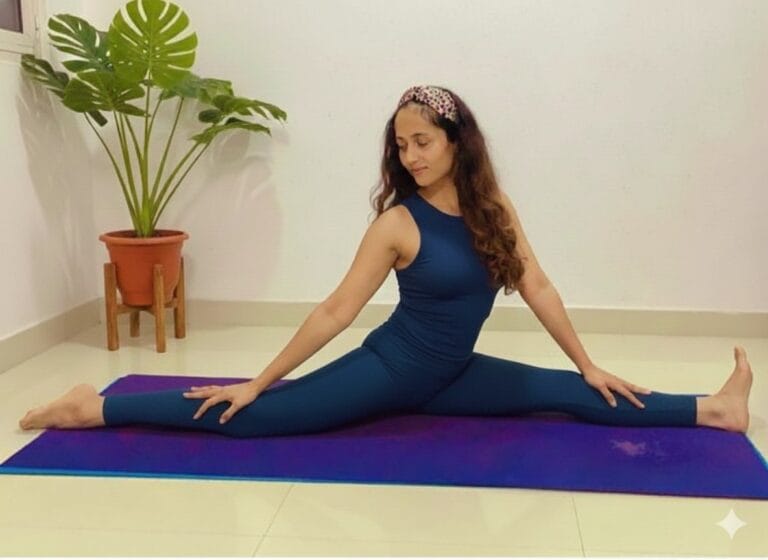
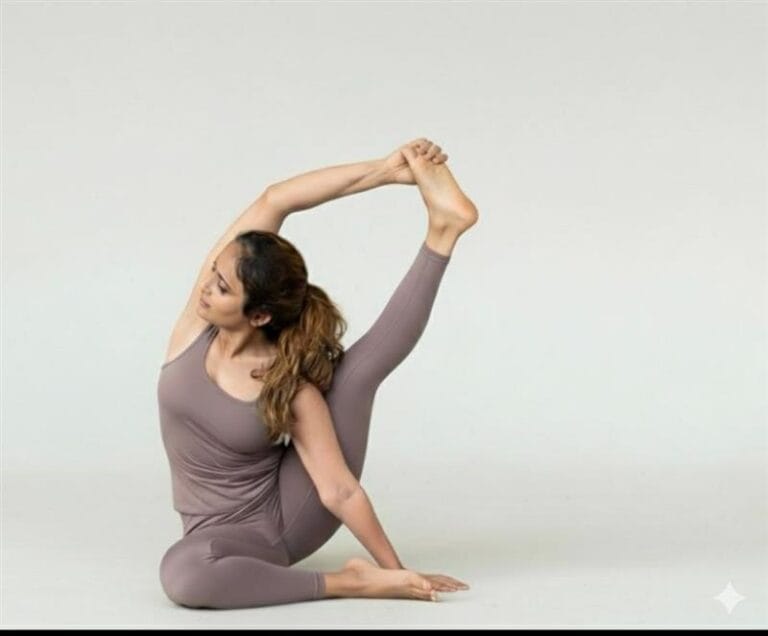
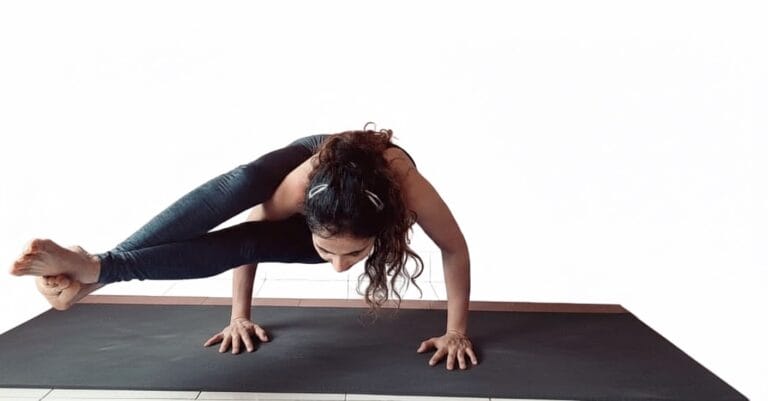
Shweta has spent ten years teaching therapeutic yoga to women with hormonal conditions, and PCOS is one of the most common reasons women come to her. She holds RYT-200, 300, 500 and 1000 certifications, is a certified pre- and postnatal yoga coach with advanced study in female anatomy and physiology, and was awarded a Doctorate in Yoga Philosophy. She has guided more than 500 women personally, in English and Hindi, across India, the Gulf, Europe and Türkiye.
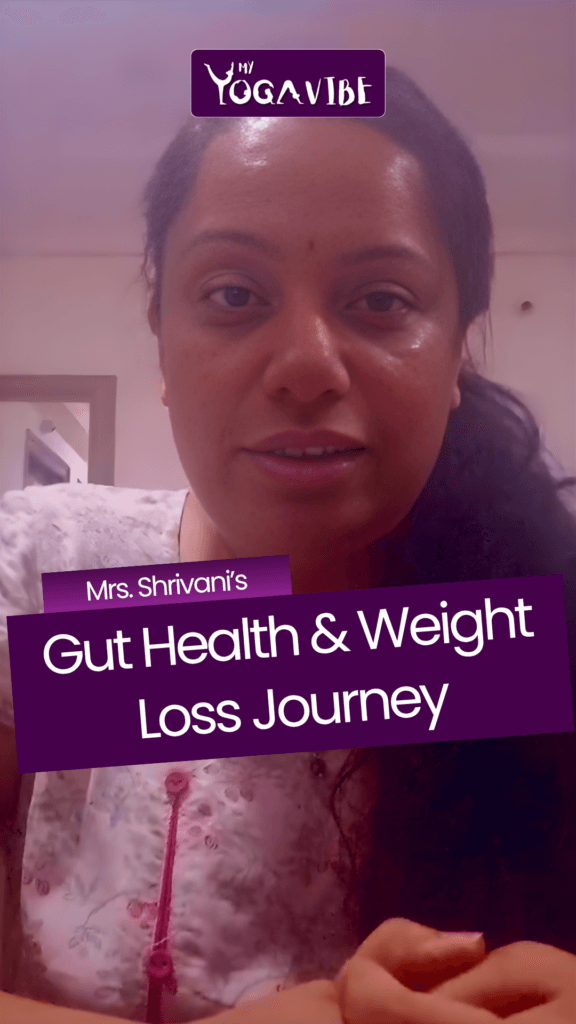
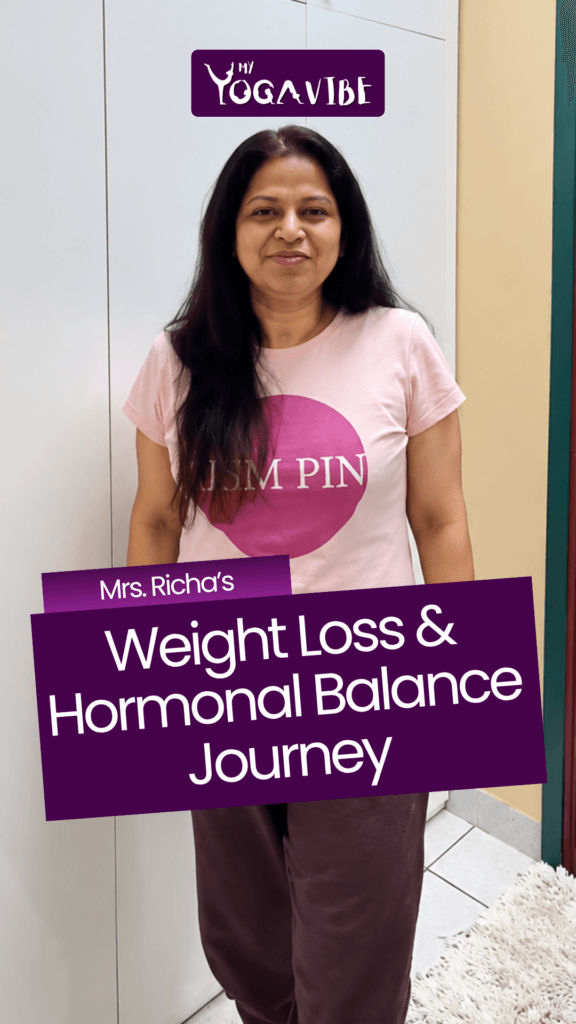
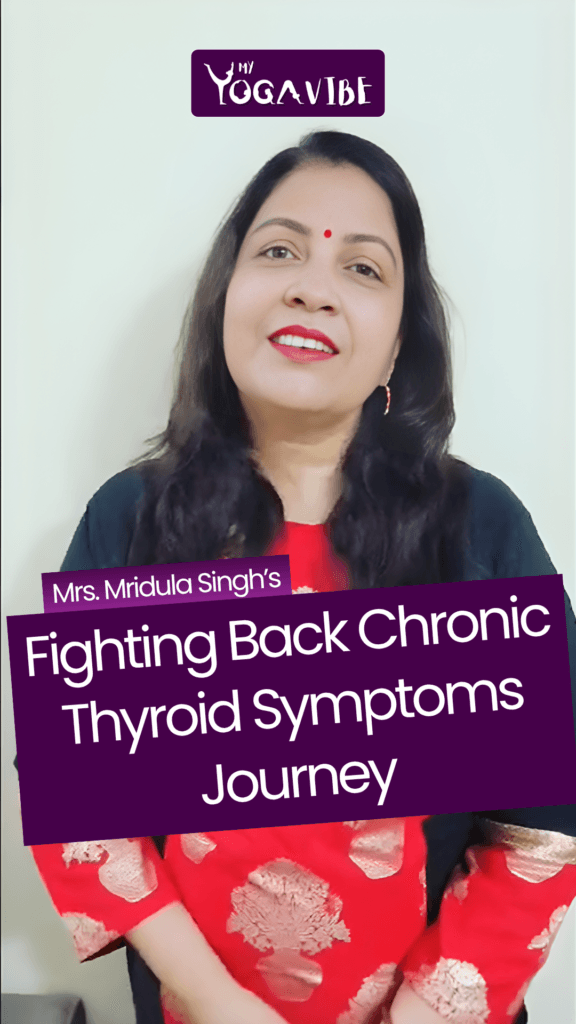
Weight Loss yoga — frequently asked questions
Read FAQs
How long does yoga take to show weight loss results?
Most women notice better sleep, less bloating and more energy within two to four weeks. Visible changes to waist size and strength usually come between weeks 8 and 12 of regular practice. If you have PCOS, a thyroid condition or are in perimenopause, progress can be slower and less linear, which is why we track waist, strength and energy alongside weight.
How many times a week should I do yoga to lose weight?
Three live, strength-focused sessions a week is a realistic and effective base for most women. On other days, aim for a daily walk and a short home practice your instructor gives you. Consistency over months matters far more than doing a punishing class every day for two weeks and then stopping.
Can yoga help with PCOS weight loss?
Yoga can support weight management in PCOS by building muscle, improving how your body uses insulin and reducing stress, which often drives cravings. It works best alongside the treatment your gynaecologist recommends and a steady Indian meal rhythm. Our PCOS sessions are planned around your cycle and energy, not a fixed routine.
Can yoga help with thyroid-related weight gain?
Yoga does not change thyroid hormone levels, so medication and your doctor’s monitoring come first. What yoga can do is rebuild the energy and strength that hypothyroidism drains, support sleep, and help you stay active without exhausting yourself. Many women find that once their dose is stable, a gentle strength-led practice helps weight start to shift.
Is online yoga as effective as an in-person class?
For weight and strength goals, a live online class with a teacher watching you can work as well as a studio, provided your camera is on and your instructor corrects your form. You also save travel time, which is often what makes three sessions a week possible for working women and new mothers.
I'm a complete beginner and overweight. Can I join?
Yes. Most of the women who join us are beginners or returning after years away. Every pose has a supported version using a chair, wall, blocks or cushions, and your instructor builds intensity only when your joints and breath are ready. The assessment is where we check what is safe for you to start with.
Do I need to diet as well?
ou won’t be put on a crash diet. Lasting weight change does need some changes to what and when you eat, so we help you structure everyday Indian meals: enough protein, fewer long gaps, earlier and lighter dinners where possible. Women who want a detailed plan can work with our nutritionist.
Can I join from outside India?
Yes. We work with women in the UAE, Singapore, the UK, the US, Canada and elsewhere, and schedule sessions in your time zone. Many of our international clients choose us because we understand Indian food, family routines and the health risks South Asian women face. International pricing is in USD and shared on your assessment call.