
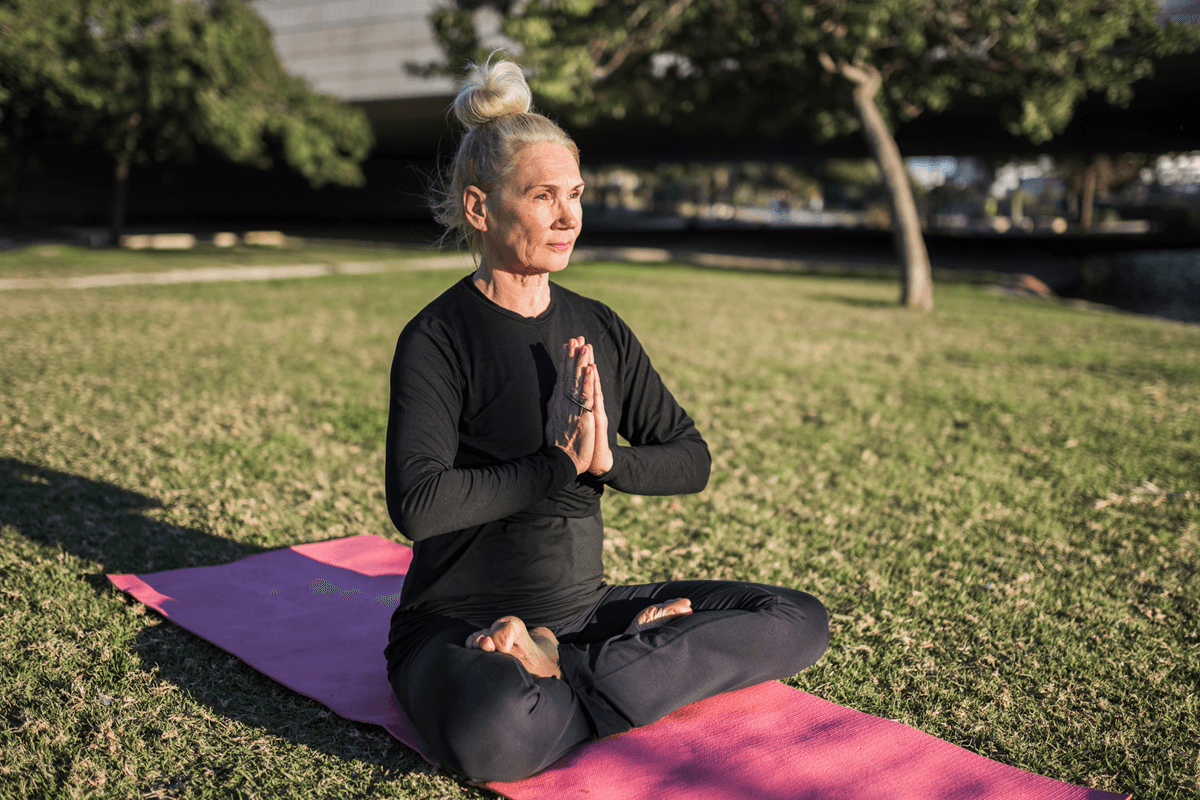
Yoga for Menopause Relief
By Shweta Rao, RYT-1000, Doctorate in Yoga Philosophy, Founder of My Yoga Vibe
Medically reviewed by Dr. Vandana, MBBS, DGO, FRM, Consultant Gynaecologist
Yes, yoga can help. Reviews of randomised trials show that regular yoga, practised two to three times a week, can ease psychological, physical and urogenital menopause symptoms and improve sleep. The evidence for hot flushes is more mixed. Yoga works best as a steady, condition-led practice of movement, breathwork and deep rest, alongside your doctor’s care, never instead of it.
Key takeaways
- Indian women reach menopause at about 46 on average, roughly five years earlier than women in the West, so symptoms often start in the early forties.
- Research is strongest for mood, anxiety, sleep, joint aches and overall symptom scores; hot-flush results vary between studies.
- Therapeutic yoga is not a fitness class: breath, rest and bone-safe strength work matter as much as the poses.
- Most women notice sleep and energy shifts in weeks three to five, and bigger changes around weeks ten to twelve.
- Keep taking any prescribed medication, including HRT, and tell your instructor about it.
Does yoga help menopause symptoms?
Yes, and the research is now large enough to say so with some confidence. A 2018 meta-analysis in Maturitas pooled 13 randomised trials with 1,306 women and found that yoga improved menopausal symptoms compared with no treatment. A 2024 meta-analysis in the International Journal of Nursing Studies reported benefits for psychological, physical and urogenital symptoms, sleep quality, anxiety and low mood.
The honest part matters too. A 2024 overview of 17 reviews in BMC Women’s Health found the clearest gains for physical and overall symptoms when yoga was practised two to three times a week. Results for hot flushes and mood were less consistent across studies. Yoga is a well-supported way to feel better through the transition, not a replacement for medical care.
Why it works, in plain terms. Menopause is not only a drop in oestrogen. It is a nervous system under strain: poor sleep raises stress hormones, stress worsens hot flushes, and fatigue makes movement harder. Slow breathing, deep rest, and steady strength work interrupt that loop at several points at once.
Start with a conversation, not a class. Book your Women’s Health & Movement Assessment: 45 minutes one-to-one with a practitioner, ₹99 in India or $19 internationally, credited in full against your first month. Bring your symptoms, your reports, and your medication list. Book your assessment →
At what age does menopause start in Indian women?
The average Indian woman reaches menopause at about 46. A pan-India survey by the Indian Menopause Society put it at 46.2 years, with irregular periods typically starting around 44 to 45. A 2021 systematic review of Indian studies arrived at 46.6 years. In Europe and North America, the average is 51.
That five-year gap changes how you should read your own body.
- Symptoms arrive earlier than most articles suggest. Western guides often describe perimenopause as a late-forties event. Many Indian women feel the first shifts in sleep, mood, and cycle length in their early forties, sometimes late thirties.
- Bone loss can start sooner. A study of 1,765 urban Indian women found osteoporosis appearing about a decade earlier than in Caucasian women. Bone-safe strength work belongs in your practice from the start, not after a scan.
- Our plates and routines matter. Vegetarian diets can run short on protein, calcium and vitamin B12. Late dinners, strong evening chai and festival fasts such as Navratri or Karva Chauth can all worsen sleep and hot flushes. These are adjusted, not banned.
- Your time is rarely your own. Joint-family households, school runs and caring for ageing parents often land hardest on women in their forties. A practice that survives a bad week matters more than a perfect one.
If you live abroad. Your GP’s benchmarks are built on an average of 51. At 43, perimenopausal symptoms are easily waved off as “normal for your age” or stress. You are not imagining it. Keep a two-week record of sleep, cycle, mood, and hot flushes, and take it to your next appointment.
Perimenopause, menopause and postmenopause: what is the difference?
Menopause is a single date: 12 months after your last period. The years before it and after it are where most symptoms live, and each stage asks something different of your practice.
| Stage | Typical age in Indian women | What is happening | What your practice should lean towards |
|---|---|---|---|
| Perimenopause | Late 30s to mid-40s | Hormones swing unpredictably; cycles change; anxiety, poor sleep and heavier or irregular periods are common | Steady strength, grounding breathwork, nervous-system down-regulation |
| Menopause | Around 46 | 12 months without a period; hot flushes, night sweats and brain fog often peak | Cooling breath, restorative poses, Yoga Nidra, consistent routine |
| Postmenopause | The years after | Oestrogen stays low; bone density, heart health, balance and pelvic floor become priorities | Load-bearing standing work, balance training, pelvic floor and core support |
Periods that stop before 40, or any bleeding after 12 months without one, need a doctor’s review before anything else.
How does therapeutic yoga help each menopause symptom?
In a therapeutic programme, the symptom chooses the practice, not the other way round. Here is how we approach the concerns women bring to us most often.
| Symptom | What we use | What to go easy on |
|---|---|---|
| Hot flushes and night sweats | Sheetali or Sheetkari cooling breath, long slow exhalations, supported restorative poses | Hot rooms, fast vigorous flows, practising straight after tea or a heavy meal |
| Broken sleep | Yoga Nidra, Bhramari (humming breath), legs-up-the-wall before bed | Stimulating backbends and fast breathing late in the evening |
| Anxiety, irritability and brain fog | Nadi Shodhana (alternate-nostril breath), Bhramari, short daily meditation | Long breath-holds if you feel panicky or light-headed |
| Joint stiffness and back pain | Gentle spinal mobility such as Cat-Cow, hip openers, props for support | Forcing depth in cold, stiff joints first thing in the morning |
| Bone density | Load-bearing standing poses such as Warrior II and Chair, balance work at a wall | Deep rounded forward folds and strong twists if you have osteopenia or osteoporosis |
| Weight settling around the middle | Strength holds, regular practice, better sleep and stress control | Expecting yoga alone to shift weight; it works alongside food, sleep and walking |
| Bladder leaks and pelvic floor | Pelvic floor awareness with breath, supported bridge, deep core activation | Heavy crunches and anything that makes you bear down |
Breathwork is not an add-on here. For hot flushes, sleep and anxiety, it is often the part of the session doing the most work.
What is the best exercise for perimenopause?
The best exercise is the combination you will keep doing: yoga for breath, rest and mobility, strength work for muscle and bone, and daily walking for the heart. Therapeutic yoga can carry much of the strength load through long, steady holds, but it should not be the only thing you do if bone density is a concern.
What separates a therapeutic programme from a general class is how it is built. Every private programme at My Yoga Vibe follows the Vibe Method, four pillars applied to your symptoms.
- Move. Asana chosen for your body today: bone-safe standing strength, balance, joint mobility, and pelvic floor support. We start where you are and build at a pace your body can sustain.
- Breathe. Pranayama is central, not optional—cooling breath for hot flushes, humming breath for sleep, alternate-nostril breathing for an anxious mind.
- Rest. Yoga Nidra and restorative postures are woven into every session. For most women in midlife, learning to rest deeply is harder than any pose, and more useful.
- Track. Every session is noted and every month is reviewed: sleep, hot-flush frequency, cycle, mood, and pain. Progress stays visible even when change feels slow.
Twelve weeks is the honest number. Hormonal change is slow biology. Most women notice sleep and energy shifting in weeks three to five, and the changes they came for somewhere around weeks ten to twelve. This is why we recommend committing to three months rather than testing yoga for one.
A gentle 20-minute menopause practice to try at home
This short sequence is a starting point, not a prescription. Practise it three times a week, ideally in the evening, and stop anything that causes pain, dizziness, or breathlessness.
- Settle and breathe (2 minutes). Sit comfortably. Breathe in for four counts and out for six. The longer exhale tells your nervous system it is safe.
- Cat-Cow (2 minutes). On hands and knees, move slowly between arching and rounding the spine with your breath. It warms the back without strain.
- Supported Bridge (2 minutes). Lie on your back, knees bent, and lift the hips. Place a firm cushion under the sacrum if you like and rest there. Gently engage the pelvic floor as you lift.
- Warrior II at a wall (3 minutes). Stand with feet wide, front knee over the ankle, arms out. Hold for five slow breaths each side. This is where the bone-loading happens.
- Tree pose with a hand on the wall (2 minutes). Balance on one foot, sole resting on the ankle or calf, never the knee. Balance training reduces fall risk as bones change.
- Legs up the wall (3 minutes). Lie with your legs resting up a wall. It calms the body and helps many women with evening restlessness.
- Sheetali breath (2 minutes). Curl your tongue and breathe in through it, then out through your nose. If you cannot curl the tongue, breathe in through closed teeth (Sheetkari). Skip this if you have low blood pressure, asthma, or a cold.
- Yoga Nidra or Savasana (4 minutes). Lie still, cover yourself if you cool quickly, and move your attention slowly through the body from toes to head.
Who should adapt or avoid parts of this practice?
Practise alongside your doctor’s care, never instead of it. Adapt or skip parts of any menopause practice if you have:
- Osteopenia or osteoporosis: avoid deep rounded forward folds, loaded twists and sit-ups.
- High or uncontrolled blood pressure: avoid inversions, breath retention and fast breathing such as Kapalbhati.
- Pelvic organ prolapse or bladder leaks: avoid bearing down, heavy crunches and jumping.
- Recent surgery, a hernia or a joint replacement: get clearance first and work with an instructor.
- Heart disease or chest symptoms: stop and seek medical advice before continuing.
Is yoga safe with HRT, thyroid or blood pressure medication? Yes, and the programme is designed to sit alongside them. Keep taking what you have been prescribed and tell your instructor. Whether HRT is right for you is a decision for you and your doctor; yoga supports either choice.
See your doctor promptly if you notice:
- any bleeding after 12 months without a period
- very heavy bleeding, or bleeding between periods
- periods stopping before age 40
- low mood that lasts most days for more than two weeks, or thoughts of harming yourself
- palpitations, chest pain, or breathlessness
Private 1-on-1 or a small group: which is right for menopause?
If your symptoms are affecting your sleep, work or relationships, or you have a diagnosis alongside menopause such as thyroid disease, high blood pressure or osteopenia, private 1-on-1 is the right starting point.
- Private 1-on-1. Twelve private sessions a month with the same instructor, sequenced only for you, with WhatsApp support between sessions and a documented monthly review. Your instructor can draw on our in-house gynaecologist Dr. Vandana, nutritionist Manisha Parmar, and lifestyle coach Sheetal. See the private programme →
- Small-group pod. Three or four women at the same stage, the same instructor, and twelve sessions a month. Close attention and a room of women who understand exactly what you are going through.
Many women begin 1-on-1 for the first quarter, while the plan is being built and corrected most often, then move to a pod once the practice is established. Your assessment is where we work out which fits you.
Frequently Asked Questions
Yoga is unlikely to stop hot flushes completely, and it should not be promised to. Some trials show fewer or milder flushes after regular practice; others show little change. What helps most consistently is cooling breathwork such as Sheetali, slow exhalations, restorative poses and fewer triggers like hot rooms, late chai and spicy dinners. If flushes are severe, talk to your doctor about medical options alongside your practice.
Two to three sessions a week is the rhythm most research uses, and it is what our private programme is built around. Most women notice better sleep and steadier energy in weeks three to five. Changes in hot flushes, mood, joint pain and strength usually take around ten to twelve weeks. Consistency matters more than intensity, so a practice that survives a busy week beats an ambitious one you abandon.
Yes, this is where yoga’s evidence is among the strongest. Slow breathing, Bhramari and Yoga Nidra calm an overactive stress response, and better sleep often lifts brain fog on its own. Many women in their early forties do not realise that new anxiety can be hormonal. If low mood lasts most days for more than two weeks, please speak to your doctor as well.
For symptoms like sleep, stress and stiffness, a well-designed yoga practice can do a great deal. For bone density, you need regular load: long standing holds, balance work and, ideally, some resistance training and brisk walking. Because Indian women tend to lose bone earlier, a therapeutic programme should include bone-safe strength work from the start, not just stretching and relaxation.
Most poses are safe with the right adaptations, but it depends on your body. With osteopenia or osteoporosis, avoid deep rounded forward folds and strong loaded twists. With high blood pressure, avoid inversions, breath retention and Kapalbhati. With pelvic floor weakness or prolapse, avoid crunches and anything that makes you bear down. An assessment is the safest way to know what applies to you.
Yoga can help, but not on its own. Midlife weight settles around the middle because of falling oestrogen, lost muscle, poor sleep and higher stress hormones. Yoga addresses the last three: it builds strength, improves sleep and lowers stress. Pair it with protein at every meal, regular walking and earlier dinners for the best results. Our nutritionist can help adapt this to an Indian vegetarian diet.
Yes. Yoga works alongside HRT, thyroxine, blood pressure tablets and most other medication. Please keep taking what your doctor has prescribed and share the full list at your assessment, so your sessions can be sequenced safely. Whether to start or stop HRT is a decision for you and your doctor. Our role is to support you whichever route you choose.
Yes. Private sessions are scheduled around your availability, not fixed batch times. Our teaching hours fall at 6:00 PM in Dubai, 7:30 PM in Singapore, mid-afternoon in London and 8:30 PM on the US East Coast, during Northern Hemisphere summer time. Sessions are live, one-to-one on video, in English or Hindi, and missed sessions are rescheduled rather than lost.
Read Other Articles
- Yoga for Stress Relief & Anxiety: A Guide for Women
 Yoga for Stress Relief, breathwork and deep rest calm stress and anxiety in women, what the research says, and safe practices for Indian women at home and abroad.
- Yoga for Infertility Among Women
 Can yoga help with infertility? What the research shows, 5 gentle poses, 2 breath practices and what to avoid, reviewed by a gynaecologist.
- Yoga for Menopause Relief
 Yoga for Menopause – How therapeutic yoga supports hot flashes, sleep, mood, joints and bone health in perimenopause and menopause, alongside your doctor’s care.