
Searching for the best online yoga classes when you are pregnant is not the same as searching for a yoga class. Prenatal yoga is a clinical decision as much as a fitness one — the right sequence at twenty-four weeks can be the wrong sequence at thirty-four, and a pose that eases one woman’s back pain can aggravate another’s pelvic girdle pain entirely.
That is why “best” is not about the prettiest studio or the largest video library. It is about whether someone qualified is watching your body, in real time, and adjusting for your week of pregnancy, your reports, and your symptoms.
This guide walks you through what to look for, what a genuinely good class does in each trimester, and how to tell a therapeutic programme apart from a pregnancy-branded workout.
What actually makes an online yoga for pregnant ladies “the best”
Most pregnancy yoga listings look identical from the outside. Use this checklist to separate them.
1. It is live, not recorded. A recording cannot see that your knee has drifted inward or that your breath has gone shallow. Live instruction means real-time correction — which matters more in pregnancy, not less.
2. The teacher is prenatal-certified, not just yoga-certified. A 200-hour general certification does not cover placental position, relaxin, diastasis recti or preeclampsia warning signs. Ask directly.
3. Sequencing changes by trimester. If the same class is offered to a woman at nine weeks and a woman at thirty-six weeks, that is a scheduling convenience, not a programme.
4. Someone asks about your medical history before you practise. Your reports, scan findings, blood pressure and any complications should shape week one — not be discovered in week five.
5. Class sizes are small, or the session is one-to-one. Twenty-five squares on a screen means nobody is watching your alignment.
6. The programme says what it will not do. Any service claiming to guarantee a natural delivery or “cure” a pregnancy complication is a service to walk away from. Yoga works alongside your obstetrician, never instead of her.
At My Yoga Vibe, every pregnancy programme begins with a one-to-one assessment, is women-only, live, and never recorded. You can see how our Prenatal Yoga programme structures each trimester before you commit to anything.
First trimester yoga modifications (weeks 1–12)
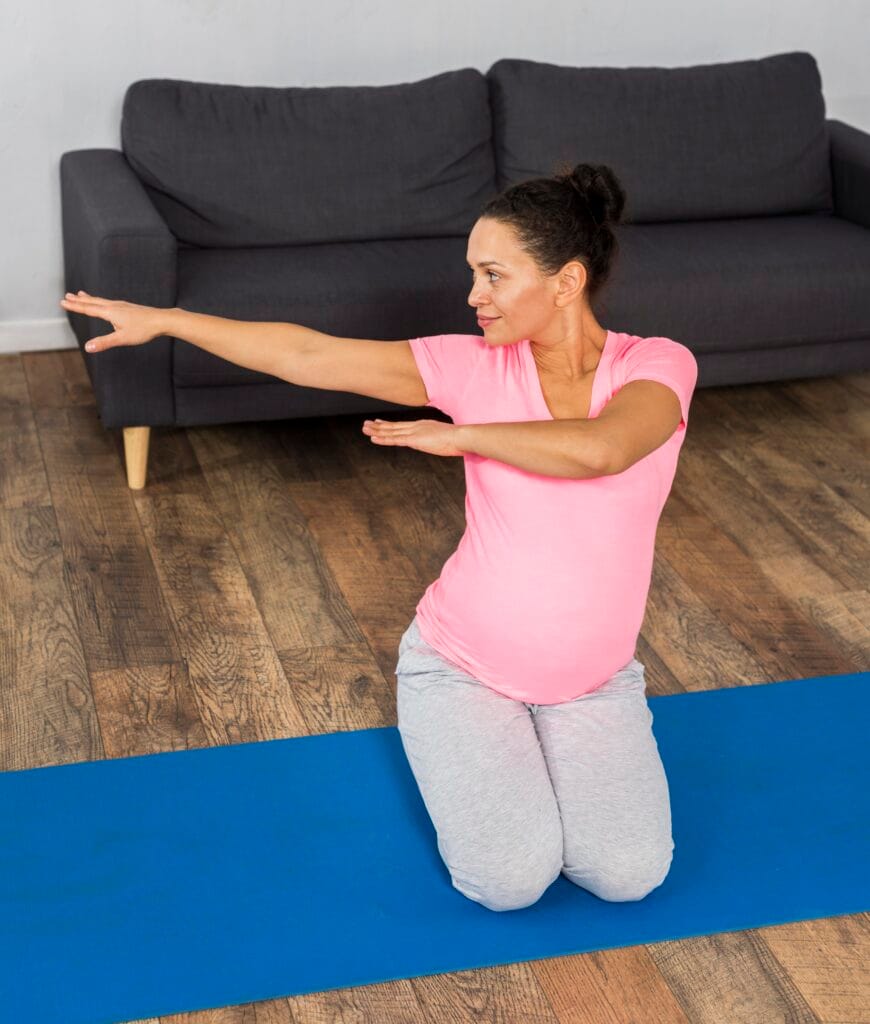
The first trimester is the quietest phase from the outside and the busiest one internally. Nausea, exhaustion, and breast tenderness arrive well before the bump does — and hormone levels shift faster now than at any other point.
Good first trimester yoga modifications look like this:
- Lower the intensity, keep the rhythm. Consistency matters more than effort. Twenty gentle minutes, three times a week, beats one ambitious hour.
- Stop compressing the abdomen. Deep twists, prone poses, and strong core work come out of the sequence now, not at twenty weeks.
- No breath retention. Kumbhaka, kapalbhati and any forceful pranayama are removed. Slow diaphragmatic breathing replaces them.
- Avoid overheating. No heated rooms, no long vigorous holds. Hydrate before and after.
- Work with nausea, not through it. Seated side openers, supported forward folds and gentle spinal waves tend to be tolerated when standing sequences are not.
If you have a history of miscarriage, are undergoing fertility treatment, or have been told you have a low-lying placenta, this is the trimester to be in a private session rather than a group batch — the pacing needs to be individual.
Get the full trimester breakdown. Our Private 1-on-1 Yoga brochure sets out the assessment process, the trimester-by-trimester structure, and what is included each month. Download the 1-on-1 brochure →
Second trimester prenatal yoga flow (weeks 13–27)
Energy returns, nausea usually settles, and this becomes the most productive phase of your practice. It is also when the anatomy changes fastest: the uterus rises, your centre of gravity moves forward, and the lumbar curve deepens to compensate.
A well-built second trimester prenatal yoga flow should now be doing three jobs.
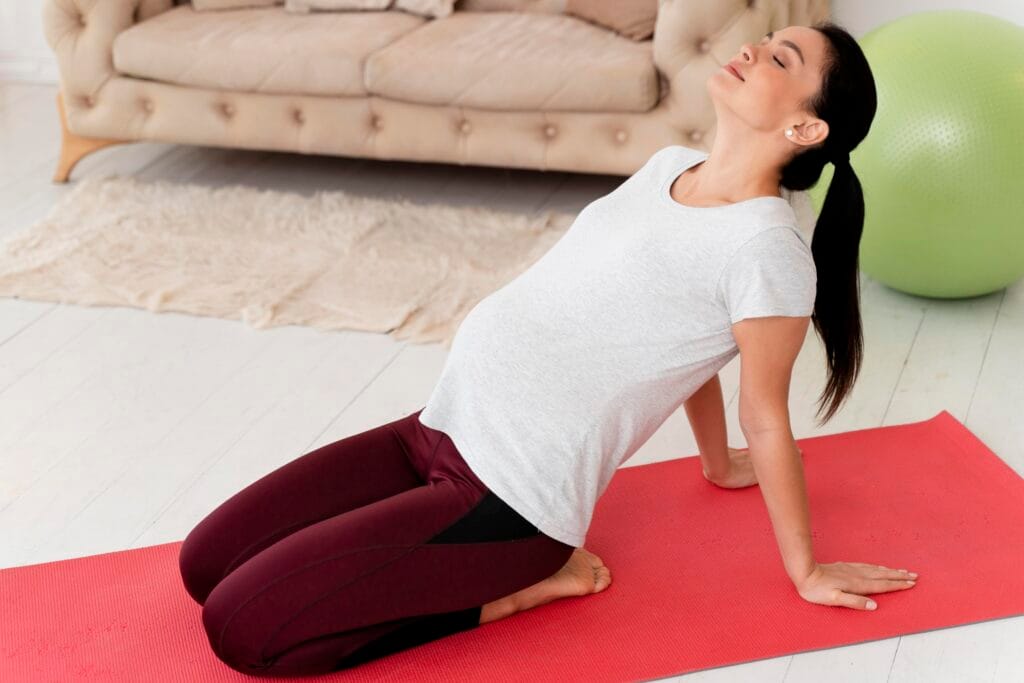
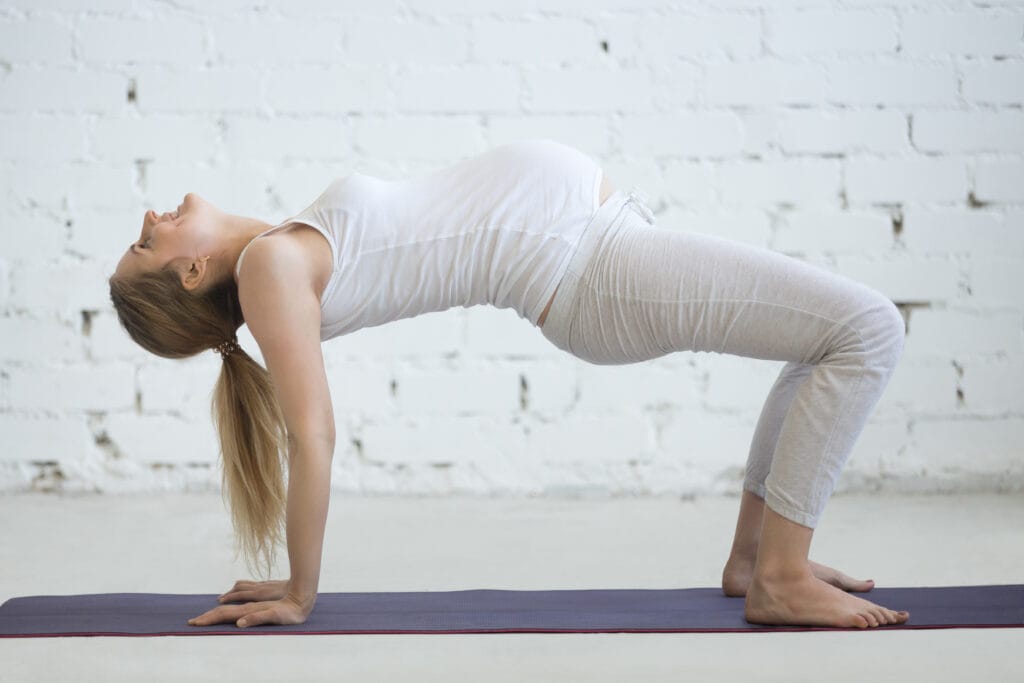
Building posterior chain strength. Gentle back extensions, supported bird-dog, and wall-assisted standing work to hold you up as the front of the body loads.
Training pelvic floor coordination — both directions. This trimester is the moment to learn release as well as engagement. Squeezing a pelvic floor that is already tight is one of the most common mistakes in pregnancy fitness.
Improving balance safely. Standing poses move closer to a wall or chair. Tree pose is not abandoned; it is supported.
Poses to retire around this point: supine work beyond a few minutes (use a left side-lying or propped incline instead), closed twists, and anything requiring you to lie flat for a long relaxation.
If round ligament pain has started — that sharp pull low on one side — sudden transitions and deep hip openers are the culprits to modify first.
Third trimester yoga for labor prep (weeks 28–40+)
Everything now slows down and becomes more supportive. Third trimester yoga for labor prep is not about achieving anything. It is about breath, space, comfort, and rehearsal.
What a strong third-trimester session includes:
- Breath work for a compressed diaphragm. As the baby moves up under the ribs, lateral rib expansion and paced exhalation become genuinely useful skills — and they are the same skills you will use in labour.
- Upright and forward-leaning positions. Supported squats (where medically appropriate), birth-ball leaning, and hands-and-knees work encourage optimal foetal positioning and take pressure off the lower back.
- Pelvic mobility without instability. Small, controlled pelvic circles rather than wide, ligament-stressing stretches.
- Side-lying restorative shapes. Fully propped, left side preferred, with bolsters between the knees.
- Labour rehearsal. Practising a long exhale through a ninety-second hold is, functionally, practising a contraction.
Squats are commonly recommended in the third trimester and commonly contraindicated as well — including with a breech presentation or a low-lying placenta. This is precisely the point at which a generic online class stops being safe and a personalised one starts earning its fee.
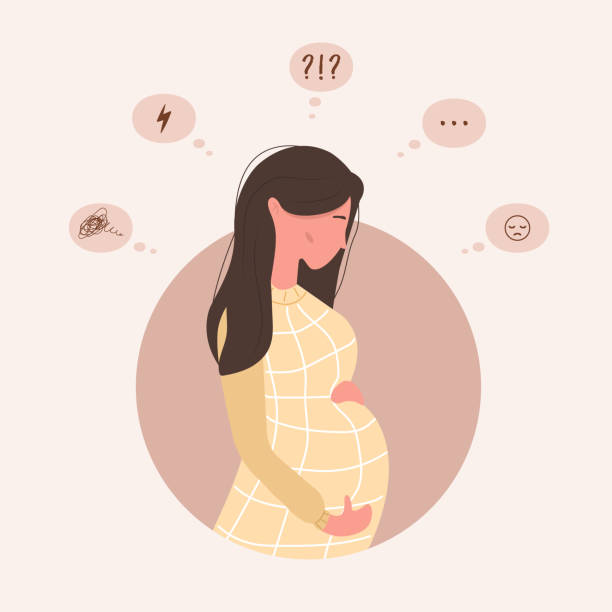
Yoga for pregnancy back pain
More than two-thirds of pregnant women experience low-back pain, and almost one in five experience pelvic pain, according to a Cochrane systematic review of interventions during pregnancy. It is common. It is not something you have to simply absorb.
Yoga for pregnancy back pain works best when it targets the cause rather than the sore spot:
- Cat–cow and pelvic tilts to restore segmental movement in a spine that has stiffened into one curve
- Supported side-lying openers to release quadratus lumborum
- Glute and deep hip strengthening — weak glutes shift the load straight onto the lumbar spine
- Standing posture retraining, especially rib-over-pelvis stacking, which does more for daily pain than any single stretch
Avoid deep backbends, and be cautious with any stretch that feels good for thirty seconds and worse two hours later. That pattern usually means you are stretching an already-overstretched, relaxin-softened structure.
Related reading on the same theme: Beyond Kegels — A Smarter Way to Train Your Pelvic Floor.
Prenatal yoga for pelvic pain
Pelvic girdle pain feels different from back pain — a grinding or clicking at the front of the pubic bone or deep in one buttock, worse when you turn in bed, climb stairs, or stand on one leg.
The instinct is to stretch it. Usually that makes it worse.
Prenatal yoga for pelvic pain should focus on stability:
- Symmetrical movements, with the legs kept close together where possible
- Isometric adductor work (a soft block squeezed between the knees)
- Transverse abdominis activation coordinated with the exhale
- Side-lying and seated sequences in place of wide-legged standing poses
- Removing lunges, warrior variations and wide squats until symptoms settle
If pelvic pain is limiting you, tell your instructor before the session, not during it, and mention it to your obstetric team as well.
Restorative yoga for pregnancy fatigue
Pregnancy fatigue is not ordinary tiredness — your blood volume is rising by up to fifty percent and your body is running a metabolic project around the clock. Pushing through it rarely helps.
Restorative yoga for pregnancy fatigue uses fully propped, long-held shapes where the body does almost no work: supported side-lying, legs-up-the-wall replaced with a legs-on-a-chair variation, reclined and bolstered heart openers at an incline, and guided yoga nidra.
There is reasonable evidence behind the mental-health side of this too. A meta-analysis of prenatal yoga trials found significant improvement in anxiety and in depression scores among pregnant women who practised yoga, with low exercise intensity being part of why it suits pregnancy so well.
If sleep is the bigger problem, our article on why your body wants to skip movement is worth ten minutes.
Prenatal stretches for sciatica relief
True sciatica in pregnancy is often not sciatica at all — it is the piriformis and deep gluteal muscles compressing the nerve, or pelvic instability referring pain down the leg.
Useful prenatal stretches for sciatica relief:
- Supported figure-four (seated on a chair, never deep or forced)
- Side-lying gentle hip abduction to strengthen the gluteus medius
- Standing calf and hamstring release at a wall, with a soft knee
- Cat–cow and gentle pelvic rocking to decompress the lumbar spine
- Sleeping with a pillow between the knees — not a pose, but frequently the single most effective change
Stop immediately if a stretch produces numbness, tingling or a sharp shooting sensation, and report it.
Yoga to open hips for birth
The phrase “hip opening” is used loosely in pregnancy yoga, and it deserves more care. The goal is not maximum range. The goal is mobility your pelvis can control, so the birth canal has space without the joints becoming unstable.
Sensible yoga to open hips for birth work includes supported malasana with blocks or a chair, butterfly with a tall spine rather than a deep fold, low supported lunges with the back knee down, and birth-ball pelvic circles.
Two important cautions. Wide, passive hip stretches held for long periods are a common cause of pelvic girdle pain later in pregnancy. And with placenta previa grades 2–4, a breech presentation, cervical cerclage, or a diagnosed preterm labour risk, hip-opening work is contraindicated without explicit, recent clearance from your doctor.
The ACOG guidance on physical activity during pregnancy is clear that exercise in pregnancy is safe and beneficial for most women in the absence of obstetric complications — the operative phrase being in the absence of complications. Which is why the assessment comes first.
Group class or private programme?
Both work. They work for different women.
| Live group prenatal batch | Private 1-on-1 prenatal programme | |
|---|---|---|
| Best for | Low-risk pregnancy, routine and community | A named complication, a difficult trimester, or an unpredictable schedule |
| Sequencing | Trimester-specific, shared | Written for your reports and symptoms, rewritten as they change |
| Scheduling | Fixed batch timings | Your three days, your window, held for the month |
| Support | In-class | Direct WhatsApp access plus written practice notes |
A private programme is the right call if you have gestational diabetes, high blood pressure, a low-lying placenta, a twin pregnancy, cervical insufficiency, a previous caesarean or preterm birth, or significant pelvic pain.
Compare all three formats on our Private One-on-One Yoga Classes page.
How to start this week
You do not need to commit to a package to find out whether this is right for you.
Book the Women’s Health & Movement Assessment — one-to-one with a practitioner, going through your history, scans, symptoms and what you actually want from the next few months. It is credited in full against your first month, and if we are not the right fit, we will say so on the call.
Download the Private 1-on-1 Prenatal Brochure
The full programme structure, trimester plan, what is included each month, and current pricing — in one PDF you can read at your own pace or share with your partner. Download the brochure · Book your 1-on-1 assessment
Led by Shweta — RYT-1000, certified pre- and postnatal yoga coach, Doctorate in Yoga Philosophy — with an in-house gynaecologist, nutritionist and lifestyle coach supporting every programme. Over 800 women have practised with the studio. Meet the team or watch their stories, including Dr. Brunda Neti on her prenatal programme.
Frequently Asked Questions
Yes, when it is live and one-to-one or in a small batch. Your instructor watches only you on screen and corrects in real time. Many of our members tell us they are corrected more often online than they ever were at the back of a studio class. What matters is live instruction and a prenatal-certified teacher — not whether you are in the same room.
Most women can begin at any point once their pregnancy has been confirmed and their doctor has cleared exercise. If you are in the first trimester with a history of miscarriage or fertility treatment, ask your obstetrician first and start with a private session rather than a group batch.
No. Most women who join our prenatal programme are beginners. Prenatal yoga is built around breath, gentle movement and relaxation, and every sequence is scaled to where your body is on day one — not to where a syllabus assumes it should be.
Yoga should be avoided, or practised only with explicit medical clearance, in high-risk pregnancies, placenta previa grades 2–4, uncontrolled blood pressure or preeclampsia, preterm labour risk, cervical insufficiency or cerclage, and where your doctor has advised against exercise. Stop and call your doctor if you experience bleeding, fluid leakage, contractions, dizziness, chest pain or reduced foetal movement.
Yes. We run trimester-specific sessions because the anatomical and hormonal demands of weeks 1–12, 13–27 and 28 onwards are genuinely different. In the private programme, the sequencing is rewritten as you move between trimesters.
Three sessions a week is the structure we build around — enough to create real change, and few enough that the programme survives a difficult week. Short home practices of ten to fifteen minutes on the days in between are shared as written notes after each session.
Nobody can promise that, and you should be cautious of anyone who does. What prenatal yoga can reasonably do is build breath control, pelvic mobility and stamina, reduce back and pelvic pain, and lower anxiety — all of which support you through labour. Delivery outcomes are determined by your clinical team and your circumstances.
Read Other Articles
- How is PCOS/PCOD Diagnosed?
 How is PCOS/PCOD Diagnosed? Book Your Assessment Class At My Yoga Vibe, we understand the complexities of navigating a wellness journey, especially when dealing with hormonal imbalances like Polycystic Ovary Syndrome (PCOS). We’re committed to empowering women on their unique paths, and that… Read more: How is PCOS/PCOD Diagnosed?
 - Prenatal Yoga BenefitsPrenatal YogaBenefits Book Your Assessment Class Prenatal Yoga Benefits At My Yoga Vibe, we understand the incredible journey of motherhood. We’re dedicated to empowering women throughout every stage, including the transformative period of pregnancy. Prenatal yoga is a beautiful practice specifically designed to… Read more: Prenatal Yoga Benefits
- How PCOS Impact your Mental Well-Being?How DoesPCOS Impact YourMental Well-Being? Book a Demo Class How Does PCOS Impact Your Mental Well-Being? At My Yoga Vibe, we understand the unique challenges faced by women with Polycystic Ovary Syndrome (PCOS). We believe in empowering women on their wellness journeys, and… Read more: How PCOS Impact your Mental Well-Being?